


Bains Rule #1 — Laugh Every Day

“Be happy, but never satisfied.” — Bruce Lee

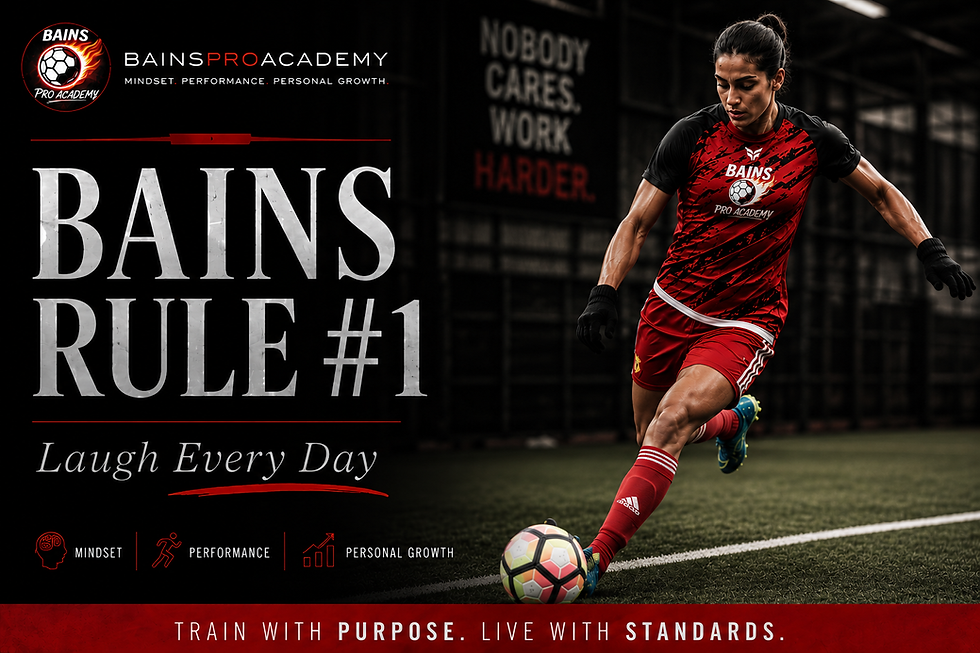
The best environments I’ve worked in - from academy football to elite performance settings - always had energy, personality and enjoyment within the standards.
Rule #1: You must laugh every single day.
Even during hard training blocks. Even during difficult moments. Even when chasing ambitious goals.
Why?
Because relaxed athletes learn faster.
Players who enjoy the process:
recover better
communicate better
handle pressure better
stay consistent longer
Football is demanding enough already. Your environment should push you - not drain you.
At BainsProAcademy, high standards matter.
But so does personality, connection and enjoyment within the process.
A player who can stay emotionally balanced under pressure has a major advantage.
Today’s Training Focus
Upper Body Strength + Conditioning
Today’s session focused on escalating load with descending repetitions.
As the weight increased, repetitions decreased: 20 → 18 → 16 → 14 → 12
Exercises
Lat Pulldown
Chest Supported Row
Lat Pull Throughs
Cable Rope Pushdowns
Dumbbell Curls
Supine Dumbbell Tricep Extensions
Hammer Curls
Conditioning
Bike completed post-session for additional aerobic work and recovery.
Key Takeaway
Enjoy the process. Train with intent. Develop every day.
Because long-term performance is built on consistency - not burnout.
Research in sport psychology has consistently shown that positive emotional states, enjoyment, and intrinsic motivation improve learning, resilience, performance consistency, and long-term athlete development. Environments that balance high standards with psychological safety often produce more adaptable and confident performers.
Reference
Fredrickson, B. L. (2001). The role of positive emotions in positive psychology: The broaden-and-build theory of positive emotions. American Psychologist, 56(3), 218–226.
Love the combination of performance focuses